
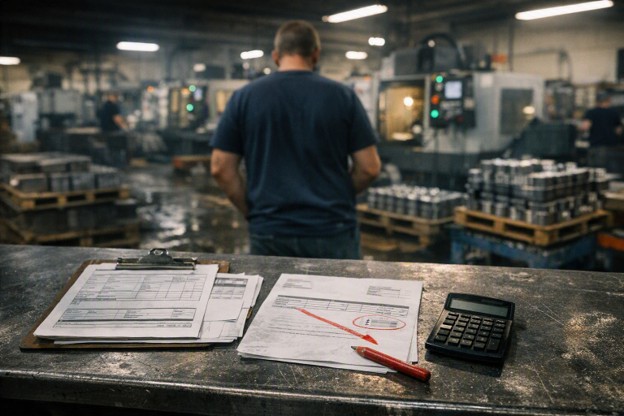
Factory Orders Hit a Four-Year High. Small Shops Are Still Losing Money
MFG Empire: Digital Marketing for Manufacturers That Drives RFQs and Growth
American factories are running hotter than they have in four years. The Institute for Supply Management reported that its Manufacturing PMI reached 55.6 percent in July 2026, the strongest reading since May 2022 and the seventh consecutive month of expansion. New orders came in at 56.7 percent, production surged to 58.5, and the employment index crossed into growth for the first time in 33 months, according to ISM’s July Manufacturing PMI report.
Read the same report a second time and a different picture emerges. The prices index registered 71.1 percent, its twenty-second straight month in rising territory. Supplier deliveries slowed for the eighth consecutive month. Order backlogs jumped 4.5 points. Steel, hot-rolled steel, cold-rolled steel, stainless, and copper all landed on the list of commodities climbing in price, and hot-rolled steel showed up a second time on the list of commodities in short supply.
That combination defines the year: more work coming in, more expensive material going out, and longer waits for both. For a 30-person job shop, it produces a strange quarter where revenue climbs and the bank balance does not.
The Quote You Wrote in March Is Not the Job You Run in July
Material is where the squeeze becomes visible first. Shops quoting fixed-price work on multi-month lead times are absorbing input costs that move faster than their contracts allow, and the gap comes directly out of gross margin. The mechanics of that trap, and what shops are doing about it, are broken down in The $1,150 Ton: How Material Volatility Is Breaking Fixed-Price Quotes.
The effect compounds. Every week between quote and cut is a week of price risk the shop owns, and buyers who accepted increases readily in 2025 have grown more resistant as their own customers push back.
The Data Nobody Puts in the Headline
The national indexes describe the sector, not the shop. A May 2026 report from the Joint Economic Committee’s minority staff, drawing on Intuit QuickBooks small business data, found that the smallest manufacturing firms lost more than 38,000 jobs between April 2025 and April 2026 while monthly revenue at those businesses fell an estimated 10.7 percent. Across all tariff-exposed industries, the Joint Economic Committee report counted 156,600 lost jobs at businesses with fewer than ten employees.
Two things are true at once. Demand is genuinely strong. And the smallest producers, the ones without hedging desks or purchasing leverage, are capturing the least of it.
Capacity Is the Real Ceiling
Rising backlogs sound like good news until you try to clear them. Shops across the country are quoting out further, running weekend shifts, and in some cases declining work they won because they cannot staff the second shift required to deliver it. That constraint has its own arithmetic, examined in The Machinist Math: Why Shops Are Turning Down Work They Already Won.
When capacity is the limit rather than demand, the strategic question changes completely. A shop that can only run so many spindle hours this quarter is no longer trying to win more jobs. It is trying to win better ones.
Mix Beats Volume
This is the part most shops underinvest in. When you can take every job that walks through the door, the front door matters less. When you can only take half, the composition of what arrives determines your year.
Shops that get found by aerospace, defense, and medical buyers searching for specific capabilities, tolerances, and certifications end up with a quote pool they can select from. Shops that rely on whoever calls end up bidding against three competitors on commodity work at the exact moment margin has no room left in it.
That is a positioning problem, not a production problem. And in 2026, it is the difference between a full backlog and a profitable one.
MFG Empire: Marketing Built by People Who Ran the Machines
MFG Empire is a manufacturing-only marketing firm serving machine shops, OEMs, and industrial manufacturers across North America. We translate shop capabilities into the language purchasing managers actually search for, so the RFQs that arrive are ones worth quoting.
Our Services Include:
- Manufacturing SEO — Getting your capabilities in front of the buyers already searching for them
- Manufacturing Website Design — Sites that showcase equipment, certifications, and completed work
Ready to improve the quality of your quote pool? Contact MFG Empire to talk through where your next qualified RFQ comes from.
About the Author
Rodney Hill is the founder and president of MFG Empire, a marketing firm built for machine shops, OEMs, and industrial manufacturers. He spent more than 25 years working directly on the shop floor across CNC machining, tool and die, fabrication and welding, and industrial machine dealerships. He troubleshot CNC controls at BobCAD-CAM and built a customer base of over 2,500 users at Dolphin CAD-CAM before turning to marketing full time.
Today he works with manufacturers across North America and overseas, many of them supplying global chains that serve Boeing, NASA, Harley-Davidson, and Tesla. Fox Business has interviewed him on economic pressure facing small manufacturers. He also holds partnerships with ten of the largest MEP networks in the United States.
Reach Rodney at rodney@mfgempire.com or 717-650-0453.
Related Articles
- The $1,150 Ton: How Material Volatility Is Breaking Fixed-Price Quotes
- The Machinist Math: Why Shops Are Turning Down Work They Already Won
Works Cited
“Manufacturing PMI at 55.6%; July 2026 ISM Manufacturing PMI Report.” Institute for Supply Management, 3 Aug. 2026, www.ismworld.org/globalassets/pub/research-and-surveys/rob/pmi/mwf4202607pmi.pdf. Accessed 4 Aug. 2026.
“Smallest Businesses Lost 4.5x More Jobs in 2025 than 2020 Amid Trump’s Tariffs.” U.S. Congress Joint Economic Committee – Minority, May 2026, www.jec.senate.gov/public/_cache/files/f159eea9-90fe-4924-8bcf-755042af6d94/jec-report-on-tariffs-small-businesses-final.pdf. Accessed 4 Aug. 2026.