MFG Empire | Marketing Built for Manufacturers, York, Pennsylvania
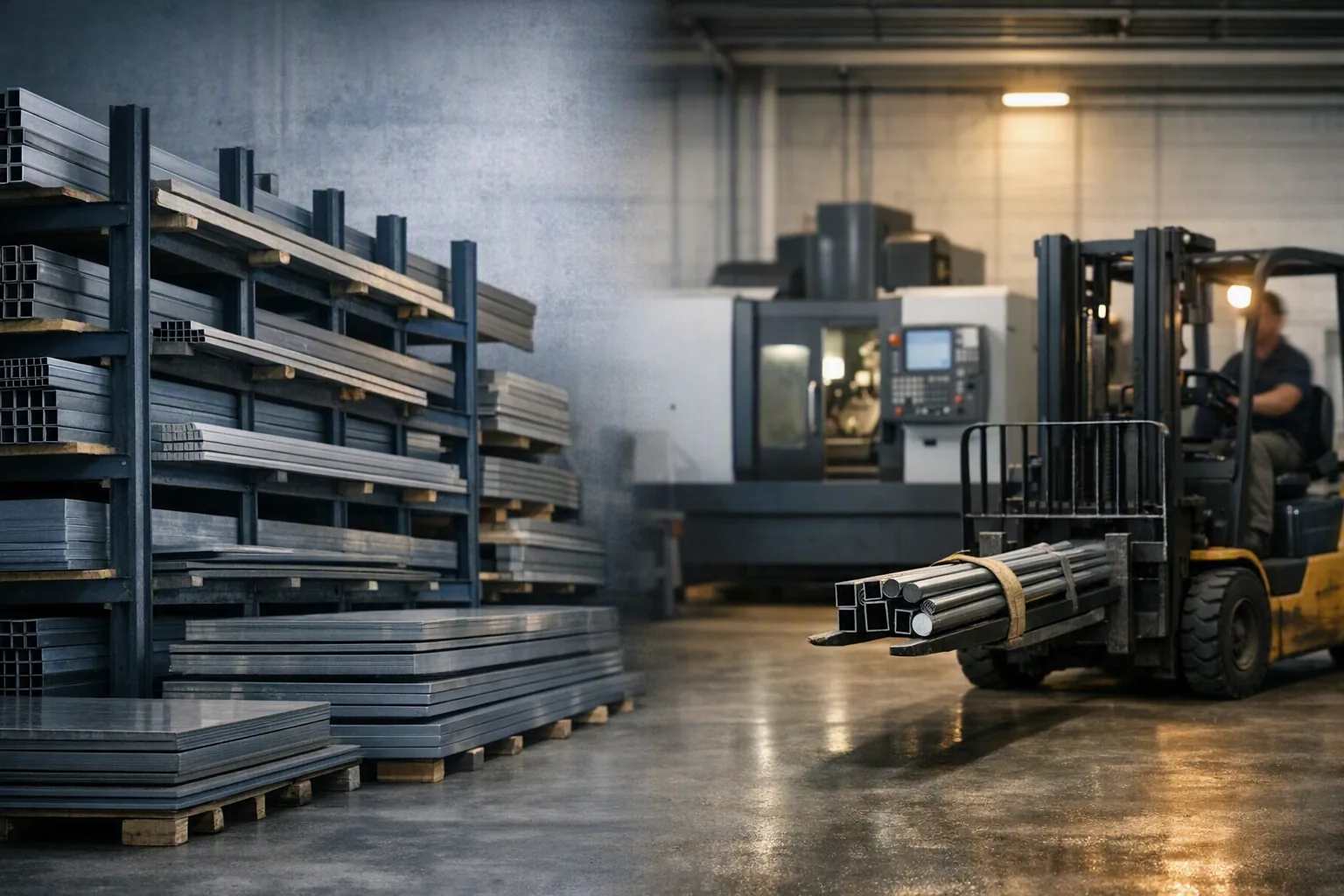
Every shop buying metal faces the same question. Carry material and tie up cash, or buy as jobs land and take the lead time.
What is safety stock and what is just in time buying?
Safety stock is material held beyond what current jobs require, bought for schedule protection. Just in time buying orders against confirmed work, close to the run date, for cash flexibility.
Neither is a strategy on its own. Each is a bet on which risk a shop can better absorb.
What are material costs actually doing right now?
The direction depends entirely on the window. The Bureau of Labor Statistics reported on 13 August 2026 on producer prices for July. Prices for processed goods for intermediate demand rose 9.9 percent over the twelve months ended in July. Those are the fabricated inputs a shop buys.
The monthly picture runs the other way. That index fell 0.6 percent in July after falling 1.1 percent in June. A shop looking at the annual number sees a reason to buy ahead. A shop looking at the last two months sees a reason to wait.
Detail matters more than the headline. Aluminum base scrap rose 5.8 percent in July while primary nonferrous metals fell. Two metal inputs moved opposite ways in one month.
What does carrying safety stock cost a shop?
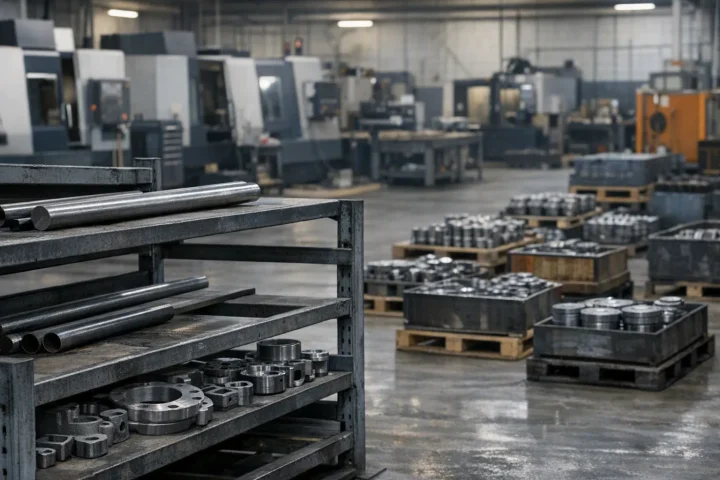
Carrying material costs cash and space. Money in bar stock is money not in a machine or a hire. Every shop owner knows that one.
The less obvious cost is price risk running backwards. Processed goods for intermediate demand rose 2.9 percent in May alone. A shop that bought heavily that month is now running jobs against material priced above the current market. Quoting against that inventory means either absorbing the difference or explaining it.
Obsolescence is the third cost. Alloy, size, and certification requirements move with the customer base. Material bought for a program that does not repeat becomes a shelf problem.
What does running just in time cost a shop?
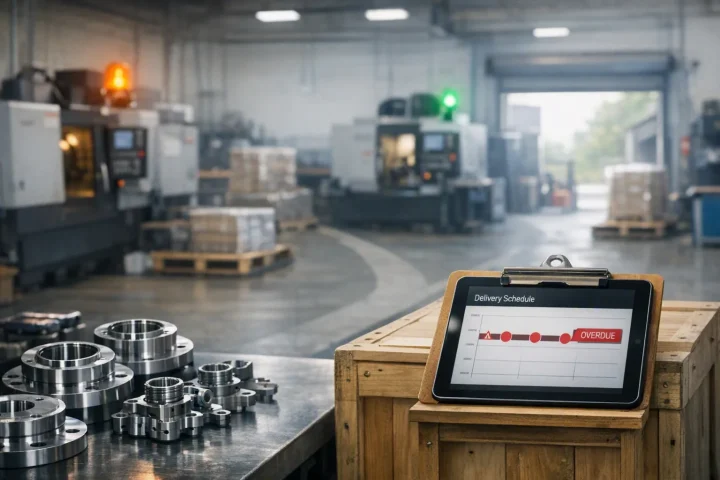
Just in time buying trades cash risk for delivery risk, and delivery risk is high right now. S&P Global reported on 21 August 2026 that supplier delivery times lengthened sharply, one of the greatest deteriorations in four years. The survey blamed shipping delays, tariffs, and thin stock at suppliers.
A shop with no buffer inherits those delays. The promise date becomes a function of the mill’s schedule, not the shop’s.
There is a second exposure. Buying at spot means paying whatever the market does between quote and release. On a fixed-price quote with a long validity window, that gap lands on the shop. The wider supply picture behind those delays is covered in why material shortages are slowing manufacturing output.
How do tariffs change the math?
Tariffs add a policy risk neither approach fully covers. Proclamation 11021 took effect on 6 April 2026, setting a 50 percent tariff on raw steel, aluminum, and copper. Derivatives above 15 percent metal content carry 25 percent.
The scope is still moving. The Bureau of Industry and Security published a notice on 6 August 2026 proposing 14 more derivative articles. That list includes parts of welding machines and apparatus, parts of heat exchange units, and parts of hydraulic engines and motors. It also covers self-propelled cranes, mobile lifting frames, several categories of trailers and semi-trailers, and certain filled steel containers.
Most would carry a 25 percent tariff. Comments closed on 27 August 2026 and a determination is pending.
That is a live list for anyone machining or fabricating those parts. It cuts in favor of carrying stock, since material bought before a scope change is priced under the old rules.
Which approach fits which kind of work?
The decision follows the work, not the market. Repeat production on known alloys and sizes carries low obsolescence risk, so stock protects the schedule and gets used.
Job shop work is the opposite case. Every print brings a different alloy, size, and certification requirement. Stocking against unknown work fills a rack nobody ordered.
Certification sharpens the split. Work requiring mill certs, traceability, or a specific heat lot cannot be served from generic stock. That work is just in time whether the shop chose it or not.
Backlog length matters too. A firm backlog gives visibility to buy against real releases. A shop quoting week to week has none.
What are shops actually doing?
They are running their buffers down. Safety stock building had been a key source of factory growth early in the Middle East conflict. S&P Global reported that it now appears to be receding.
The Philadelphia Fed found the same. Its inventories index turned negative at -3.7 in August, down from 0.3 in July.
Upstream tells a different story. Census reported primary metals inventories up for a seventeenth consecutive month in July, rising 1.5 percent to $51.9 billion. The material is building at the mills and service centers, not on shop floors.
How should a shop decide?
Start with the exposure the shop cannot survive, not the cheapest one. A shop with thin working capital cannot carry stock whatever the tariff schedule does. A shop facing liquidated damages on late delivery cannot run bare.
Then price the quote to match the buying method. A fixed price quoted against just in time buying carries two risks at once, material cost and delivery. Shortening quote validity moves part of that risk back.
The slipped promise date itself is covered in how purchasing managers respond to supplier lead time misses.
There is no correct answer here, only a matched one. A shop that knows which risk it carries is better placed. The danger is picking a method and never revisiting it.
This article is general industry information and is not financial, legal, or trade compliance advice. Conditions change. Confirm current figures with the cited source.
Frequently Asked Questions
What is the difference between safety stock and just in time buying?
Safety stock is material held beyond current job requirements, bought to protect a delivery schedule. Just in time buying orders material against confirmed work, close to the run date, to protect cash. Safety stock absorbs supply risk with capital. Just in time absorbs cash risk with schedule exposure.
Are material prices going up or down in 2026?
Both, depending on the window. Bureau of Labor Statistics data published 13 August 2026 shows processed goods for intermediate demand up 9.9 percent over twelve months, while the same index fell 0.6 percent in July and 1.1 percent in June. The annual trend and the monthly trend disagree.
Does a machine shop need to carry steel inventory?
That depends on the work, not the market. Repeat production in known alloys and sizes carries low obsolescence risk, so stock tends to get used. Job shop work with changing prints, alloys, and certification requirements carries high obsolescence risk, and generic stock often cannot satisfy traceability requirements anyway.
Which steel and aluminum products face new tariffs?
The Bureau of Industry and Security proposed adding 14 derivative articles on 6 August 2026. The list covers parts of welding machines, parts of heat exchange units, parts of hydraulic engines and motors, self-propelled cranes, several trailer categories, and certain filled steel containers. Comments closed 27 August 2026.
How does inventory strategy affect a fixed-price quote?
It changes which risk the quote carries. A quote priced against material already on the rack locks a known cost. A quote priced against future purchases carries both the market movement between quote and release and the supplier lead time. Quote validity length determines how much of that exposure the shop absorbs.
Are manufacturers building or drawing down inventory right now?
Shop-level buffers are shrinking while upstream stocks build. The Philadelphia Fed inventories index turned negative at -3.7 in August 2026, and S&P Global reported precautionary stockbuilding receding. Census reported primary metals inventories rising for a seventeenth consecutive month to $51.9 billion in July.
MFG Empire: Manufacturing Only
MFG Empire works with manufacturers and nobody else. The firm is based in York, Pennsylvania and was founded by Rodney Hill, who spent more than 25 years running and supporting shop floor equipment before moving into marketing. Material cost, lead time, and quoting practice are the conditions its clients work under every day.
Where inventory and quoting decisions become visible to a buyer:
- Manufacturing website design: Sites organized around process, capacity, and completed work rather than stock photography
- SEO for manufacturers: Built around how buyers describe the work in their own vocabulary
Website not producing quote requests?
Ask for a review and we will look at what is actually published.
About the Author
Rodney Hill is the founder and president of MFG Empire, a marketing firm in York, Pennsylvania built for machine shops, OEMs, and industrial manufacturers. He spent more than 25 years working directly on the shop floor across CNC machining, tool and die, fabrication and welding, and industrial machine dealerships. He troubleshot CNC controls at BobCAD-CAM and built a customer base of over 2,500 users at Dolphin CAD-CAM before turning to marketing full time.
Today he works with manufacturers across North America and overseas, many of them supplying aerospace, space, powersports, and automotive programs. Fox Business has interviewed him on economic pressure facing small manufacturers. He also holds partnerships with ten of the largest MEP networks in the United States.
Reach Rodney at rodney@mfgempire.com or 717-650-0453.
Works Cited
Bureau of Industry and Security. “Request for Public Comments on the Proposed Implementation of Duties on Additional Aluminum, Steel, and Copper Derivative Articles Under Section 232.” Federal Register, vol. 91, 6 Aug. 2026, p. 50756, www.federalregister.gov/documents/2026/08/06/2026-15961.
Federal Reserve Bank of Philadelphia. “Manufacturing Business Outlook Survey: August 2026.” Federal Reserve Bank of Philadelphia, 20 Aug. 2026, www.philadelphiafed.org/surveys-and-data/regional-economic-analysis/manufacturing-business-outlook-survey.
S&P Global Market Intelligence. “S&P Global Flash US PMI: August 2026.” S&P Global, 21 Aug. 2026, www.pmi.spglobal.com.
United States Bureau of Labor Statistics. “Producer Price Indexes: July 2026.” United States Bureau of Labor Statistics, 13 Aug. 2026, www.bls.gov/news.release/archives/ppi_08132026.htm.
United States Census Bureau. “Monthly Advance Report on Durable Goods Manufacturers’ Shipments, Inventories and Orders: July 2026.” United States Census Bureau, 26 Aug. 2026, www.census.gov/manufacturing/m3/adv/current/index.html.
Related Articles
Material Shortages Are Slowing Manufacturing Output as Backlogs Reach $1.6 Trillion
When Lead Times Slip, Buyers Start Looking for a Second Source