
MFG Empire | Marketing Built for Manufacturers, York, Pennsylvania
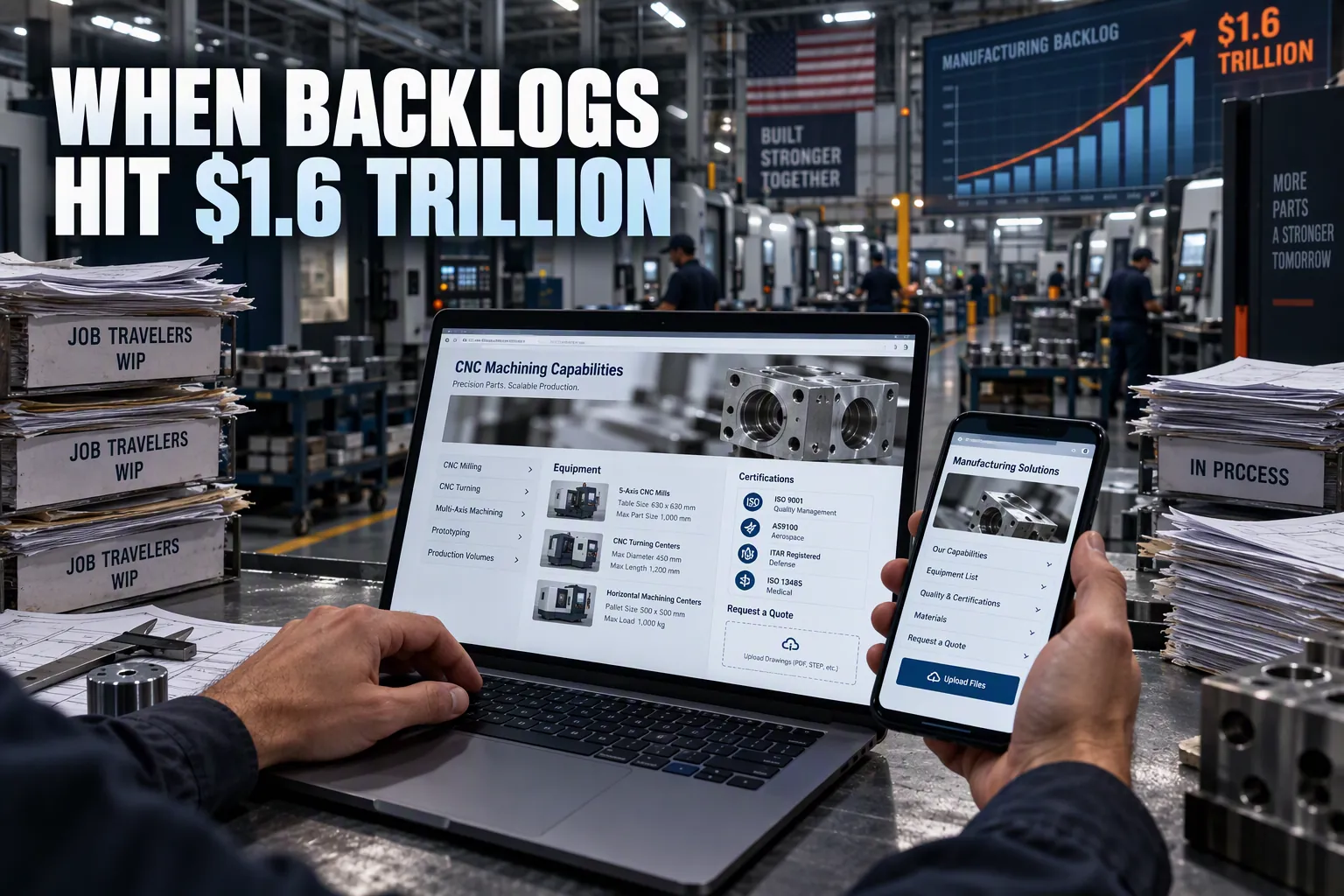
U.S. manufacturers are holding more work than they can ship. The Census Bureau’s full report released September 2, 2026 put July unfilled orders at $1,600.3 billion, up in 24 of the last 25 months. New orders rose 0.9 percent to $663.6 billion in the same release, according to the U.S. Census Bureau.
MFG Empire, a York, Pennsylvania marketing firm founded by Rodney Hill, works only with manufacturers, and a backlog like this changes how buyers find shops. When a primary supplier’s lead time stretches, purchasing managers often start looking for a second source. That search usually begins on a phone or laptop, well before anyone sends an RFQ. Industrial website design decides what that buyer finds.
What a Buyer Checks Before Calling a Shop
A sourcing engineer vetting a new supplier runs a qualification checklist in their head. Can this shop hold the tolerance? Does it run the material? Is the quality system certified? Will the part fit the machine envelope?
Many shop websites answer none of those questions. They show a hero photo of a CNC mill, a paragraph about quality and service, and a contact form. The buyer leaves because the qualifying facts are missing, not because the shop is wrong for the job.
Solid industrial website design puts the qualification data where the buyer expects it:
- Capability pages by process. One page each for 5-axis milling, Swiss turning, wire EDM, or fabrication, with real part examples.
- Equipment lists with numbers. Make and model, axis travels, spindle speeds, bar capacity, press brake tonnage.
- Tolerances and materials stated plainly. If the shop holds ±0.0005 in. on turned features in 17-4 PH, the page should say so.
- Certifications with scope. AS9100, ISO 9001, or ITAR registration, along with what each one covers.
- An RFQ form built for drawings. Accept STEP and PDF files, ask for quantity and material, and explain how NDAs are handled.
Those pages also hand search engines the vocabulary they need, which our companion piece on industrial SEO and the terms engineers search covers in depth.
Why the Mobile Version Is the Real Website
Google uses the mobile version of a site’s content for indexing and ranking, according to Google Search Central. That detail matters more for shops than most owners realize.
A common build hides the equipment list behind a “load more” button on phones. Google’s documentation states its crawler won’t load content that requires a click, swipe, or typing to appear. If a machine list only loads on tap, search engines may not see it at all.
The same documentation asks for matching content, headings, and image alt text across mobile and desktop. For a manufacturer, that means the phone version carries the full capability story rather than a trimmed brochure.
Design That Feeds AI Answers Too
AI answer engines pull facts from the same pages search engines index. A page that says “precision machining services” with no tolerances, materials, or equipment gives a search engine little to match and an AI engine nothing to quote. How those engines choose what to cite is broken down in industrial AEO versus SEO.
In short, the website is the foundation. SEO and AEO both build on it, and neither can add facts the site left out.
Five Checks to Run on Your Own Site This Week
Open your site on a phone and act like a buyer:
- Can you find your certifications in two taps?
- Does each process have its own page with a real part photo?
- Are machine models and travels listed as text rather than inside an image?
- Does the RFQ form accept a CAD file?
- Does every page say where the shop is and which industries it serves?
Each “no” marks a spot where a qualified buyer may leave without calling. With backlogs this deep across the sector, a site that answers those questions on the page gives a buyer a reason to stay.
Frequently Asked Questions About Industrial Website Design
What should be on an industrial manufacturing website?
An industrial manufacturing website should give a buyer the facts needed to qualify a supplier: a page for each process, an equipment list with models and travels, materials by grade, tolerance ranges, certifications with scope, industries served, and an RFQ form that accepts drawings. Real shop photos carry more weight than stock images.
Does a machine shop website need an equipment list?
Yes. Sourcing engineers check whether a part fits a machine before they request a quote, so a machine shop website should list make, model, axis travels, spindle speeds, and bar or tonnage capacity. Keep the list as plain text on the mobile version, because Google indexes the mobile site and skips content hidden behind a tap.
Where should certifications appear on a manufacturing website?
Certifications such as AS9100, ISO 9001, and ITAR registration belong on a dedicated page and on every capability page they apply to. Buyers in aerospace, defense, and medical work often screen suppliers on certification first, so a shop that buries its registrar details on an About page makes qualification harder than it needs to be.
What should an RFQ form on a manufacturing website ask for?
A manufacturing RFQ form should ask for part quantity, material, delivery date, and any finishing or certification requirements, along with a file upload that accepts STEP, IGES, and PDF drawings. A short note on NDA handling helps buyers who cannot share prints without one. Keep required fields to what an estimator needs to quote.
How much does industrial website design cost?
Industrial website design cost depends on scope rather than a fixed rate. The main drivers are the number of process and capability pages, whether content writing and on-site photography are included, RFQ and CAD upload features, and ongoing maintenance. MFG Empire scopes each project after a discovery call with the shop owner.
MFG Empire: Websites Built From the Shop Floor Up
Rodney Hill founded MFG Empire after more than 25 years on shop floors, including time troubleshooting CNC controls at BobCAD-CAM. That background shapes how the agency builds capability pages, equipment lists, and RFQ paths for machine shops and fabricators.
Services that fit this topic:
- Manufacturing Website Design: Capability, equipment, and certification pages organized around how buyers qualify suppliers
- Website Maintenance for Manufacturing: Updates, backups, and fixes that keep equipment lists and RFQ forms current
Wondering what a buyer sees on your site?
Request a quote and we will walk through it with you.
Works Cited
Google Search Central. “Mobile Site and Mobile-First Indexing Best Practices.” Google for Developers, 10 Dec. 2025, developers.google.com/search/docs/crawling-indexing/mobile/mobile-sites-mobile-first-indexing. Accessed 3 Oct. 2026.
U.S. Census Bureau. “Monthly Full Report on Manufacturers’ Shipments, Inventories, & Orders.” Release CB26-135, 2 Sept. 2026, www.census.gov/manufacturing/m3/current/. Accessed 3 Oct. 2026.