
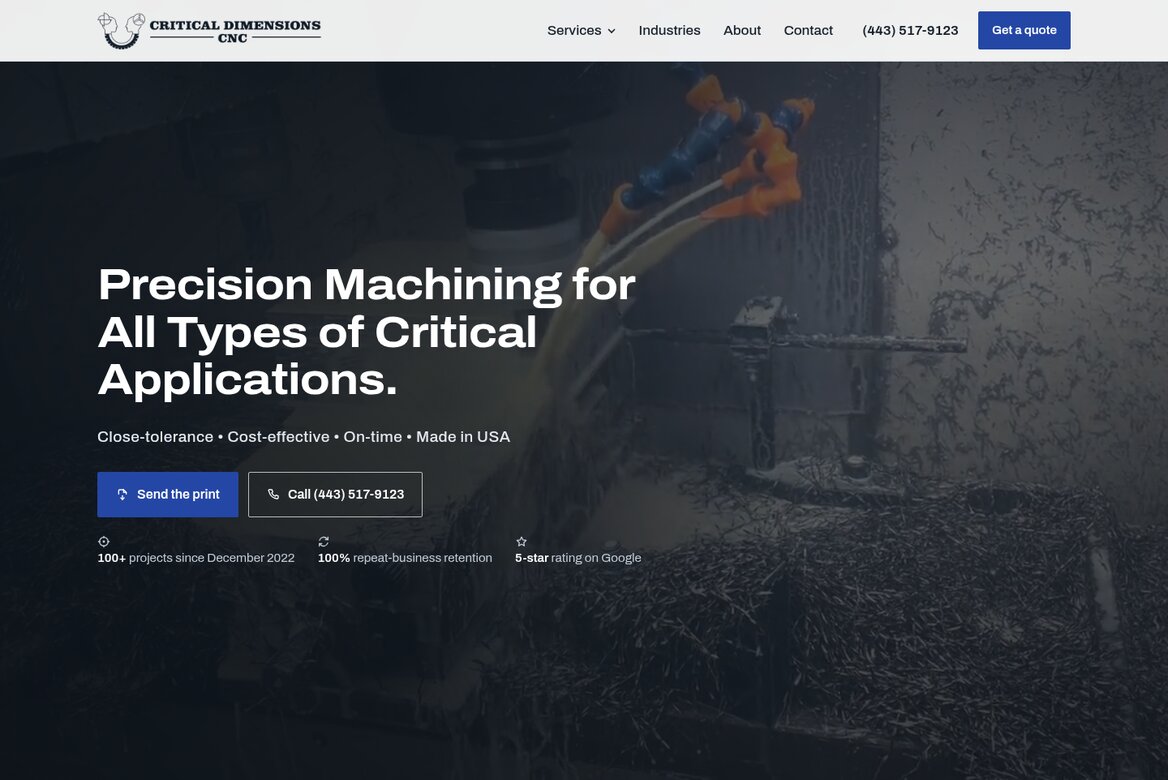
The Project: Bringing Critical Dimensions CNC’s Machining Expertise Online
Critical Dimensions CNC is a family-owned precision machine shop in Owings Mills, Maryland. Jeremy Dillon founded the company in December 2022 after more than a decade in aerospace manufacturing. The shop specializes in close-tolerance parts, difficult materials, and short runs. It takes on jobs where the geometry, material, or setup calls for a careful look at the print before anyone commits to making the part.
The shop offers precision CNC milling, CNC turning with live tooling, in-house 3D printing, and reverse engineering under one roof. Its material range runs from Delrin and polycarbonate to titanium and Inconel. The shop has achieved tolerances down to 0.0001 inch on specific features and evaluates each new requirement against the part geometry, material, and setup. That combination supports customers in aerospace and defense, electronics, robotics, medical, marine, and automotive manufacturing.
The work can start with a production drawing, a CAD model, or a worn part pulled from a machine. A buyer might need a short run of Inconel components. An engineer might need a printed prototype to check the fit before machining the final part. A maintenance team might have a worn splined sleeve and no original drawing. Critical Dimensions CNC can review those jobs, determine what the part needs, and handle the necessary work in-house.
The Challenge: Getting Found for the Work the Shop Does Best
Critical Dimensions CNC needed more visibility for the jobs it was set up to take on. Buyers searching for a Maryland shop that will quote a short run in Inconel or machine a replacement from a worn sample tend to search for the process, material, or problem they have in front of them. A broad description of the company as a precision machine shop gives those buyers little to go on when they’re looking for one specific capability.
Getting found was only the first hurdle. Once a buyer landed on the site, they needed enough information to put the shop on a shortlist. A purchasing manager reviewing suppliers for a close-tolerance part wants to see the materials the shop runs and how it verifies dimensions. An engineer sourcing a turned component with a cross-hole wants to know how those features can be machined in relation to each other. A maintenance team with an obsolete part needs to know what the shop can learn from a worn sample and what it needs to confirm before making a replacement.
The website also needed to make it easy for those buyers to send useful quote requests. Someone with a complete drawing can provide tolerances, material, and quantity right away. Someone working from a broken component may only be able to describe what it does and share a photo. Both are legitimate inquiries. The site needed to give each buyer a clear place to start and give Jeremy enough information to evaluate the job.
What MFG Empire Did: Website Design, SEO, and AEO Built Around the Print
We used our manufacturing website design process to organize the site around how engineers and purchasing teams source machined parts. The homepage opens with the shop’s close-tolerance focus and gives buyers a direct path to its services, materials, inspection practices, and quote options. A purchasing manager can review the shop’s capabilities before reaching out. A buyer with a print ready to go can send it from the homepage.
We made “Send the print” the primary call to action because that’s how Jeremy starts reviewing machining work. The homepage pairs it with a direct phone option for customers who need to talk through a feature, material, or deadline before submitting files. The same path carries through the service pages, so buyers can request a quote as soon as they’ve found the capability they need.
We built separate pages for CNC milling and CNC turning. The milling page explains how workholding and in-house CAM programming factor into complex parts and close dimensional relationships. The turning page explains how live tooling can add flats, cross-holes, and keyways while the part is still in the chuck, where the geometry allows. Keeping those operations in one setup can reduce handling and help maintain the relationship between the turned diameter and the milled feature. That’s a detail a buyer can apply directly to the print they’re sourcing.
The 3D printing page helps engineers decide whether a printed prototype will do the job. A printed part can be useful for checking fit before machining the final component. Load, mating surfaces, and dimensional requirements can change that decision. We explained how Critical Dimensions CNC reviews the model and what the part has to do before recommending a process.
The reverse engineering page starts with a situation maintenance teams recognize. A part is worn or broken, the equipment still has service life left, and the drawing is gone. We laid out how the shop measures the existing component, builds a CAD model, and checks critical mating dimensions before cutting the replacement. A photo of the worn splined segments beside the new sleeve shows the original problem and the finished work together.
We used photos of actual parts and setups throughout the site. The milling page shows a profiled plate with drilled and counterbored holes. The turning page shows a steel cylinder set up between centers. Paired with the service descriptions, those images let a buyer see the kinds of features and setups the shop works with before they send over their own print.
Our manufacturing SEO work gave each capability its own search destination and connected it to related services and industries. A search for low-volume CNC milling in Maryland can lead to a page about milling, materials, tolerances, and inspection. A search for live-tooling CNC turning can lead to the page explaining which features can be completed in one setup. A buyer looking to reproduce an obsolete part can go straight to the reverse engineering process.
For manufacturing AEO, we wrote headings and FAQs around the questions that come up when a buyer is qualifying a shop. Can you make one replacement part? Can you work from a worn sample? Should this part be printed or machined? What tolerances have you held? The answers explain where the shop has experience and which decisions require a review of the actual part. That gives buyers and answer engines specific information about what Critical Dimensions CNC does and where it fits.
We also put supplier qualification details where buyers could find them. The site covers Jeremy’s aerospace background, in-house CAM programming, and the shop’s use of ANSI/ASQ Z1.4 acceptance sampling at AQL 1.0%, Level II. It lists CAGE code 9NC83 for procurement teams checking federal registration. The homepage includes a testimonial from Fabpro Technologies describing parts the shop made with tolerances as tight as ±0.0001 inch.
The full RFQ form gives buyers room to provide the process, quantity, material, tolerances, and deadline, along with a drawing or CAD model. If there’s no print, they can describe the component and what it does. Jeremy reviews the geometry, material, tolerances, and setup before quoting. The information requested on the site reflects what he needs to make that call.
The finished website gives Critical Dimensions CNC a dedicated page for each of the jobs it wants buyers to find it for. A buyer can start with a specific problem, see how the shop handles it, and send Jeremy the details needed to review the work.
Is YOUR Manufacturing Business Next?
If your shop takes on work buyers struggle to source, your website should help them find you for that work, see how you handle it, and know what to send for a quote. Contact MFG Empire today and let’s build it.